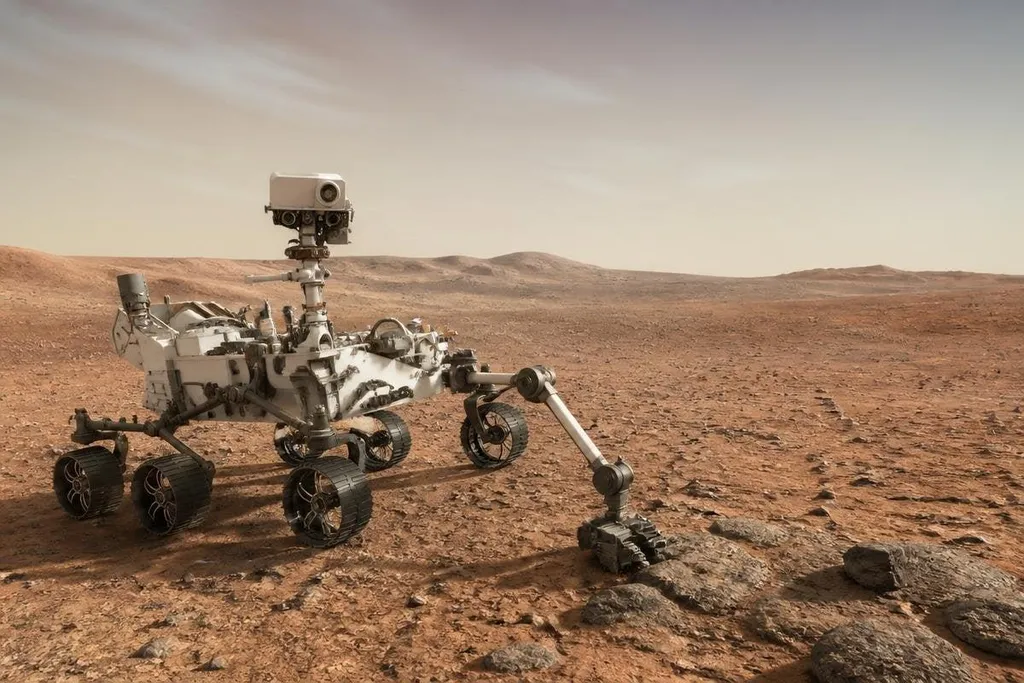
Mars is about 225 million km from Earth at its greatest distance. A radio signal can take between 4 and 24 minutes to travel one way, so a robot there cannot wait for a person to approve every move. That delay makes autonomous machines the practical first step for exploring the planet.
- Robots can work where a human suit would be at risk.
- Curiosity has operated on Mars since August 2012.
- The hard limits are power, dust, distance, and repairs.
Why people cannot lead every task
Mars has a thin atmosphere, intense cold, and surface dust that can cover cameras, solar panels, and moving parts. A human crew would need air, water, food, shelter, radiation protection, spare parts, and a way to return home.
A rover carries a smaller set of needs. It still needs power and heat control, but it does not need oxygen or a pressurized cabin. Its operators can send a group of commands, then let the rover choose a safe path around rocks and slopes.
That gap matters most during routine work. A person on Earth can tell a rover to drive toward a rock, but the rover must check the ground under its wheels, watch for hazards, and stop if the route becomes unsafe.
The machine handles those seconds because the signal delay makes live control impossible.
What Mars robots actually do
NASA's Curiosity landed in Gale Crater in August 2012. Its science work includes drilling rock, checking soil, and measuring the chemistry of samples. The rover's data helps scientists decide which places deserve closer study.
NASA's Perseverance reached Jezero Crater in February 2021. It studies rocks and stores selected samples for a possible future return mission. The rover also carried Ingenuity, a small helicopter that completed its first powered flight on another planet in April 2021.
These machines do more than take photographs. Cameras build maps, spectrometers check minerals, and drills reach material below the surface. A robot can also repeat a task across many locations, which gives scientists a better view of how the ground changes.
The work is slow. The rover may spend hours checking a route that looks clear in an image. That caution protects a machine that cannot receive a repair visit from Earth. It also gives the science team time to study each result before choosing the next target.
A Mars rover can't wait for a technician to replace a worn motor. Reports on robots in the field offer useful comparisons for the hardware and software choices that keep machines working far from direct control. The next section looks at where Mars makes those choices harder.
The limits are real
Robots reduce the danger to people, but they do not remove the engineering problems. Mars missions need launch vehicles, landing systems, radio links, software, and power systems that must work far from a repair shop.
Solar power can fall when dust blocks sunlight. Radioisotope power systems can run for years, but they add mass and bring strict handling rules. Wheels wear down, drills can jam, and a stuck rover may have no practical way to free itself.
Autonomy also has limits. A rover can detect a slope or rock, yet it may not understand the science value of a site as well as a geologist. Scientists still choose broad goals, review images, and change plans when new data arrives.
The strongest opposing view is that people make better decisions in the field. That is true for many science tasks, but sending people first would add life-support and rescue systems before Mars has proved safe enough for a crew.
I’d send robots first, then use their results to decide where people could work.
A practical test for the next Mars mission
Use these checks when judging a proposed Mars robot or mission plan:
- Mission target: Name the rock, soil, ice, or terrain feature the robot will study.
- Command delay: Allow for a one-way delay of up to 24 minutes when planning control tasks.
- Power plan: State how the robot works through dust, winter, and reduced sunlight.
- Repair plan: List the faults the robot can detect and handle without Earth-based tools.
- Science return: Explain which measurements will change the next mission's route or design.
A robot earns its place on Mars when its sensors, software, and power system answer a clear science question for years rather than days. The next useful step is not a larger promise; it is a machine that can keep working after Earth loses contact for a full day.